
Blogs/Articles | Page 9 of 11 | Hydrogengentech

Bring to the table win-win survival strategies to ensure proactive domination. At the end of the day, going forward, a new normal that has evolved from generation.
slider1-1280x453.png

May 16, 2023by Team HGPL0

In recent years, there has been a growing global interest in hydrogen as a sustainable and clean fuel source. With its zero-emission potential, hydrogen has the potential to revolutionize the way we think about energy and transportation. And now, the Chamba Administration in the Indian state of Himachal Pradesh is taking the lead in producing hydrogen fuel through hydroelectric power.


Method of Production of Hydrogen Fuel
Hydrogen fuel is produced by splitting water molecules into hydrogen and oxygen through a process called electrolysis. The hydrogen produced can be used in fuel cells to generate electricity, or in combustion engines to power vehicles. When hydrogen is burned, the only byproduct is water vapor, making it a completely clean source of energy.

The government’s plan to produce hydrogen fuel is a significant step towards reducing carbon emissions in the region. Himachal Pradesh is a mountainous state in northern India, and air pollution is a major concern in many of its cities. Hydrogen fuel has the potential to significantly reduce emissions from the transportation sector, which is a major contributor to air pollution.

Benefits of Hydrogen Fuel
Moreover, the production of hydrogen fuel through hydroelectric power has several benefits. Hydroelectric power is a renewable source of energy that does not produce greenhouse gas emissions. By using hydroelectric power to produce hydrogen fuel, the administration is ensuring that the fuel is produced sustainably and with minimal impact on the environment.

Another benefit of hydrogen fuel is that it can be produced locally, reducing dependence on imported fossil fuels. With the rising prices of crude oil and natural gas, producing hydrogen fuel locally could provide a cost-effective and sustainable alternative to fossil fuels.

In conclusion, the Chamba Administration’s plan to produce hydrogen fuel through hydroelectric power is a significant step towards a sustainable and clean energy future. It is hoped that this project will inspire other states in India and around the world to invest in hydrogen fuel technology and help us move towards a cleaner and greener future.

army.jpg

April 5, 2023by Team HGPL0

The Indian Army has taken a major step towards promoting sustainable energy by signing an MoU with National Thermal Power Corporation Renewable Energy Limited (NTPC REL) for the installation of a Green Hydrogen-based Micro Grid Power Plant project in the Northern borders. This initiative aligns with the National Green Hydrogen Mission, which seeks to promote the use of renewable energy and reduce dependence on fossil fuels.


Under the MoU, the Indian Army will provide land on lease for 25 years and commit to purchasing the generated power through a Power Purchase Agreement (PPA). The proposed project will be set up by NTPC on Build, Own, and Operate (BOO) Models at a mutually identified location in Eastern Ladakh. The project will involve the installation of a Solar Power Plant for the hydrolysis of water to produce Hydrogen. The Hydrogen produced will then be used to power fuel cells during non-solar hours, thus reducing dependence on fossil fuel-based generator sets and contributing towards the abatement of greenhouse gas emissions.

This project is a significant milestone for the Indian Army, as it is the first government organization to enter into an agreement with NTPC REL for such a project. It sets the stage for similar projects in the future, promoting sustainable energy and reducing the country’s dependence on fossil fuels. This initiative will not only benefit the environment but also help meet the energy requirements of the Indian Army in remote areas where there is no access to national/state grids.
Overall, the Indian Army’s decision to install a Green Hydrogen-based Micro Grid Power Plant project is a major step towards promoting sustainable energy in the country. The success of this project will pave the way for similar initiatives, encouraging other government organizations to adopt sustainable practices and contribute towards the goal of reducing greenhouse gas emissions.


20230322_211723_0000.png

March 22, 2023by Team HGPL0

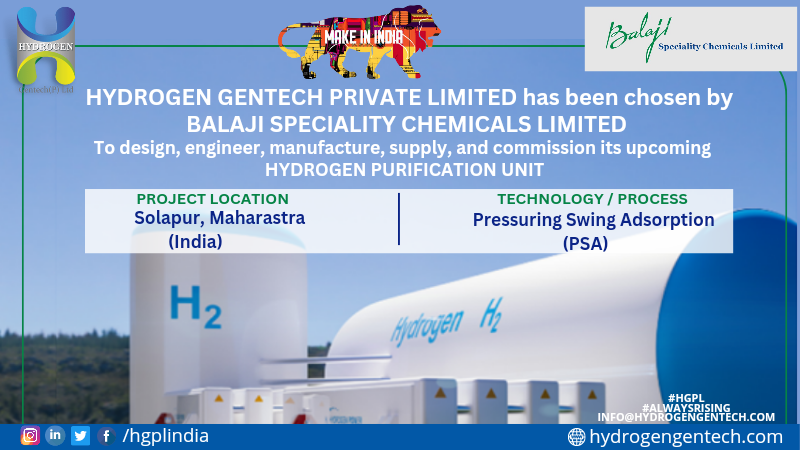
Balaji Speciality Chemicals Limited (BSCL), a subsidiary of Balaji Amines Limited, has selected Hydrogen Gentech Private Limited (HGPL) to design, engineer, manufacture, supply, and commission its Hydrogen Purification Unit. The unit will generate high-purity hydrogen using the Methanol cracking process.

To produce high-purity hydrogen, the H2 Purification process technology involves a process study of the composition of mixed gas received at the outlet of the Methanol cracking reactor. This study determines the suitable adsorbents required to remove each impurity via adsorption-based removal and achieve the desired purity level of the hydrogen product.


The PSA-based hydrogen purification system will have five towers working cyclically in different phases of H2 generation and tower regeneration stages. Each of the five towers will cyclically work in high purity H2 generation mode while the other four towers operate in different stages of pressurization, depressurization, equalization, and regeneration modes. This design allows for the continuous generation of pure H2.

The adsorber tower for the PSA-based hydrogen purification system will consist of a customized multi-layered, molecular sieve-based adsorption bed system based on the type and quantum of impurities present in the mixed gas streams. The design will ensure that high-purity H2 is generated while minimizing the loss of any H2 during the adsorption process.

HGPL’s scope of work includes detailed engineering, procurement, manufacturing, supply, erection supervision and commissioning, Performance Guarantee Test Run (PGTR), and training. The PGTR will ensure that the unit performs as per the specified parameters and guarantees the performance of the system.

The Hydrogen Purification Unit will be fully automatic, with a control system that includes all safety measures. The PSA-based hydrogen purification technology is a popular route to establish small and medium capacity H2 generation plants, making HGPL a fast-emerging key technology player in India in the field of Hydrogen generation and Purification systems using the Methanol cracking process.

Hydrogen Gentech Private Limited (HGPL) is an international technology-based Hydrogen Generation Plant EPC Company, manufacturer, and supplier based in India. The company has a clear focus on Green Hydrogen Generation, Purification, Recovery & Storage solutions & their applications in Industry, Renewable Energy, Fuel, and Mobility sectors.


Hydrogen-Plant.jpg

March 18, 2023by Team HGPL0

India has an abundance of coal reserves and is currently exploring ways to utilize them for hydrogen production. According to RK Malhotra, Member of India’s task force on coal-based hydrogen production, India can start producing blue hydrogen from coal mined from its abundant reserves, without waiting for green hydrogen to become commercially viable.

While green hydrogen, produced from renewable sources, is often considered the most sustainable form of hydrogen, blue hydrogen is produced by using fossil fuels such as coal, but with the addition of carbon capture, utilization, and storage (CCUS) technology. Blue hydrogen is a feasible pathway for the hydrogen economy and can contribute to India’s net zero goals, argued Malhotra.

To expedite the integration of CCUS technologies with coal gasification, Malhotra called for the establishment of commercial plants of 7,500-25,000 TPD at different pithead locations. The hydrogen produced from coal can reduce dependence on imported natural gas and can be injected into natural gas for use as HCNG fuel in vehicles and H+PNG mixture fuel in cooking.

Currently, there is only one operational coal gasification project in India, run by Jindal Steel and Power Ltd (JSPL) in its Angul plant. However, to address the lack of availability of coal for gasification, Coal India Ltd (CIL) has introduced a separate auction window for coal gasification. In addition, the government has announced several incentives for companies who want to use coal blocks won under the commercial mining regime for coal gasification.

While there is no doubt that green hydrogen is the most sustainable form of hydrogen, India’s abundance of coal reserves presents a unique opportunity to produce blue hydrogen using CCUS technology. As the country works towards achieving its net-zero goals, it is essential to explore all possible avenues for hydrogen production, including blue hydrogen from coal.


December 7, 2022by Team HGPL0

India’s National Hydrogen Energy Mission, which was established in 2021, aims to make that nation a centre for environmentally friendly hydrogen by 2030, with a target of 5 million tonnes yearly. These lofty goals are hindered by unsolved infrastructure obstacles, a lack of sufficient incentives, and insufficient access to technologies.

“Investment in hydrogen grid networks is required to successfully incorporate these as the major source for mainstream companies. Future hydrogen projects may run the danger of failing due to a lack of green hydrogen infrastructure for storage, transport, and production. Since hydrogen is currently generated and used in the same place, building common infrastructure and clusters of demand and consumption would be necessary to achieve economies of scale for big green hydrogen facilities and the development of the hydrogen economy. 

According to Prof. S Dasappa, Chair of the Interdisciplinary Centre for Innovation, “Industry, government, and investors need to work together to create an environment where innovation is encouraged, where market demand is posted, and where collaboration between different players in the supply chain is also encouraged.” These comments were made by Prof. Dasappa at the International Climate Summit 2022, which took place in Bergen, Norway, on August 30 and 31, and had as its theme “Opportunities for Green Hydrogen in India.” 

The Norwegian partnership was represented by Greenstat, Arena H2Cluster, and the Norwegian Hydrogen Forum, while the Indian partnership was represented by the PHD Chamber of Commerce and Industry and Invest India. 

Prof Dasappa said that The government policies need to cover the entire value chain of hydrogen from demand creation to supply and to market enablers such as infrastructure and supply chain development. 

Alok Sharma, Executive Director at Center for High Technology (CHT) and Treasurer of Hydrogen Association of India said that The natural gas industry is considering adding hydrogen to natural gas for use in transportation and as a fuel for cooking. As part of India’s national hydrogen mission to determine the technological and economic viability of mixing hydrogen in city gas distribution networks, the Gas Authority of India has begun injecting hydrogen into natural gas supplied to houses for cooking purposes in central India.

 Similar studies are said to have been conducted in the UK, where it may be decided to blend 20% hydrogen with home natural gas by the winter of 2023. Such actions result in their starting conditions. The use of green hydrogen as a sustainable natural gas, however, would be very beneficial.


December 7, 2022by Team HGPL0

The state currently needs about 0.9 million tonnes of hydrogen per year, mainly for the manufacturing of nitrogenous fertilizers. The policy concentrates on the chemical, fertilizer, and refinery industries in an effort to move the state toward a green hydrogen economy. For the following five years, the policy will be in force.

Additionally, by 2028, the state hopes to blend 20% green hydrogen into all hydrogen used by its existing fertilizer and refinery units. The draft policy suggests a capital expenditure subsidy in 2024 equal to 60% of the electrolyzer’s cost. The minimum capacity needed to be eligible for the subsidy is 50 MW or more. The financial incentive from the state government will be cut in half to 20% by 2027.

Additionally, a state-level committee will be established to take care of all the obligations, including the monitoring and evaluation of the policy. Additionally, the plan calls for providing R&D facilities and companies with the one-time financial support of 30% for the procurement of technology up to a maximum of Rs 50 million.

A skill-development program will be supported by the center in order to strengthen state capabilities and get the workforce ready for the transition to green hydrogen and ammonia.

The move is a precursor to rolling out the final policy that would aim to make Uttar Pradesh a 100% green hydrogen/ammonia-consuming state by 2035. Turning the state into a leading green hydrogen/ammonia producer is another objective.

The policy would also promote green hydrogen/ammonia production, market creation, and demand aggregation.

“The state envisions to promote green hydrogen/ammonia as the foundational pillar for the green energy transition in UP and make the state ready for a net-zero economy in the future,” says the draft policy that was put in the public domain by the Uttar Pradesh New and Renewable Energy Development Agency (UPNEDA), the nodal agency for the purpose.

The policy will focus primarily on two major hydrogen/ammonia demand centers in Uttar Pradesh – nitrogenous (N) fertilizers and the refinery sector. It will also cover other emerging industries and applications of green hydrogen in the future.

Incentives provided in the “Industrial Investment and Employment Promotion Policy 2017”, such as exemption of stamp duty, tax reimbursement, capital interest subsidy, infrastructure interest subsidy, and electricity duty will be applicable to new green hydrogen/ammonia investments and expansion of existing fertilizer units in the state.


November 19, 2022by Team HGPL0

Analysts predict hydrogen could meet up to 24 percent of the world’s energy needs, Thomas Sattich and Charis Palmer report.

Green hydrogen, which is created by splitting water molecules into hydrogen and oxygen using renewable electricity, has the potential to significantly reduce greenhouse gas emissions while assisting in meeting the world’s energy needs. Additionally, there is a need for means to ensure and authenticate the fuel’s origin as well as an internationally accepted definition of “green hydrogen.”

By 2050, the demand for hydrogen is projected to increase to 500–680 million metric tonnes (MT), from an anticipated 87 million MT in 2020. The market for hydrogen production was evaluated at $130 billion between 2020 and 2021, and it is anticipated to expand by up to 9.2% annually until 2030. However, there is a catch: only a small portion of the current hydrogen production, which accounts for over 95% of it, is “green.” Today, the production of hydrogen uses 6% of global natural gas and 2% of global coal.

However, there is a resurgence of interest in environmentally friendly hydrogen manufacturing techniques. This is due to the fact that hydrogen’s potential applications are growing in a variety of fields, including power generation, manufacturing processes in the steel and cement industries, fuel cells for electric vehicles, heavy transportation like shipping, production of green ammonia for fertilizers, cleaning products, refrigeration, and grid stabilization.

Governments around the world have already committed more than USD 70 billion to stimulate the hydrogen industry.

The obvious early movers are heavy industries looking to decarbonize, industrial shipping, and heavy vehicles. Large power utilities are eyeing it off for storage. All of these players are largely linked to the existing oil and gas industry. As countries transition to sustainable energy, oil, and gas-led economies could lose USD 7 trillion by 2040, the International Energy Agency has warned.

Additionally, the commercial viability of green hydrogen production has increased due to the declining cost of renewable energy sources, decreasing electrolyzer costs, and increased efficiency brought on by technological advancements. The forecast of the Levelized cost of hydrogen production for major projects worldwide through 2050 is depicted in the figure below.

Locating facilities for the generation of hydrogen and renewable energy close to one another will allow for greater integration of these projects, positioning them for success. Governments must also establish legal and policy frameworks that encourage investment.


November 19, 2022by Team HGPL0

According to two officials aware of the development, the government has selected 10 potential states that might serve as important facilitators for India’s National Green Hydrogen Mission by facilitating the production of green hydrogen. Karnataka, Odisha, Gujarat, Rajasthan, Maharashtra, Tamil Nadu, Andhra Pradesh, Kerala, Madhya Pradesh, and West Bengal are some of these.

The Indian government has identified states which have the potential to become green hydrogen manufacturing hubs. These are the states most likely to have green hydrogen or ammonia manufacturing zones or clusters, which will aid India in the early years of its National Green Hydrogen Mission.

These states have been chosen based on the refineries, ports, and steel and fertilizer industries, as well as the current and potential renewable energy generation capacity in the areas. As another industry that can offtake green hydrogen, we have also integrated the city gas distribution network at some locations, according to a senior official in the ministry of new and renewable energy (MNRE).

On November 2, during the first day of the three-day Invest Karnataka 2022 – Global Investors Meet, the Karnataka government signed a set of agreements totaling Rs 5.20 lakh crore. The Karnataka government intends to create India’s first green hydrogen manufacturing cluster or zone through the use of Rs 5.20 lakh crore, of which Rs 2.9 lakh crore will be invested in the green hydrogen and derivatives industry alone.

The nation’s top producer of steel, Odisha, has also made the decision to promote the production of green hydrogen and green ammonia. Steel production can be done more sustainably by employing green hydrogen, which is produced by splitting water using solar and wind energy.

Additionally, this can lessen the industry’s reliance on imported coking coal. The state is presenting itself to investors as a center for the export of green hydrogen in addition to having several important ports and creating new ones. 6,000 square kilometers of land parcels in Banaskantha and Kutch in Gujarat have been set aside solely for hydrogen projects in the state.

Tamil Nadu has given the ACME Group permission to invest Rs 52,474 crore in a green hydrogen and ammonia project. The proposed facility would feature a 1.5 GW electrolyzer, a 5 GW solar power plant, and 1.1 million tonnes of ammonia production capacity. It also includes research and development work, pilot projects, enabling policies and regulations, and infrastructure development.


November 16, 2022by Team HGPL0

Linde revealed that Bremervörde, Germany now has the first hydrogen refueling facility for passenger trains in the entire globe.

With the help of the 14 hydrogen-powered passenger trains that Linde created, owns, and operates, each train will be able to travel 1,000 kilometers without emitting any emissions after just one refueling.

One of the biggest hydrogen refueling systems ever constructed, it has a daily capacity of roughly 1,600 kg of hydrogen.

Coradia iLint, the world’s first passenger train powered by a hydrogen fuel cell, was made by the French group Alstom.

Linde has installed over 200 hydrogen fueling stations and 80 hydrogen electrolysis plants globally, the company noted.

The system will supply 14 Coradia iLint hydrogen-powered passenger trains in the town of Bremervorde, Rotenburg district. With a single refueling, the trains will be able to run 1,000 kilometers (621.4 miles), Linde said on Wednesday, adding that those trains are expected to gradually replace the existing diesel-powered fleet.

The possibility to integrate future on-site green hydrogen generation was a key consideration in the design and construction of Linde’s future-ready hydrogen refueling system. The new hydrogen trains will replace the current trains that are powered by diesel.

Veerle Slenders, President RegionEurope West, Linde, stated that the company was “dedicated to making a significant contribution towards decarbonizing transport in Europe.” We take great pride in the fact that Linde’s cutting-edge technology is essential to this project’s success and is serving as a model for greener public transportation systems everywhere.

According to Müslüm Yakisan, President of Alstom in Germany, Austria, and Switzerland, “The world’s first hydrogen train, the Coradia iLint, exhibits a strong commitment to green mobility paired with the newest technology.” With our partners Linde, LNVG, and evb, we are extremely happy to witness the first series of operations in action.

Linde is a global leader of the world in the production, processing, storage, and distribution of hydrogen. It has the largest liquid hydrogen capacity and distribution system in the world. The company operates the world’s first high-purity hydrogen storage cavern plus pipeline networks totaling approximately 1,000 kilometers globally, to reliably supply its customers. Linde is at the forefront of the transition to clean hydrogen and has installed over 200 hydrogen fueling stations and 80 hydrogen electrolysis plants worldwide. The company offers the latest hydrogen technologies through its world-class engineering organization, key alliances, and partnerships.


September 13, 2022by Team HGPL0

The Coradia iLint, the world’s first hydrogen train, has reached another significant milestone in Bremervörde, Lower Saxony, Germany, according to an announcement from Alstom. It is now used on the global premiere 100% hydrogen train route, in passenger operation.

This local train makes only low-level noise when running and solely produces steam and condensed water. Landesnahverkehrsgesellschaft Niedersachsen owns 14 vehicles with fuel cell propulsion (LNVG). Finding alternatives to diesel trains was something LNVG had already begun looking into in 2012, which gave the German railway industry a boost. The gas and engineering company Linde as well as the Elbe-Weser railways and transport business (evb) are additional project partners for this global premiere.

“One of the most essential objectives for ensuring a sustainable future is emission-free mobility, and Alstom has a clear intention to lead the world in alternative propulsion systems for rail. The Coradia iLint, the first hydrogen train in the world, illustrates our unwavering dedication to environmentally friendly mobility while utilizing cutting-edge technology. Together with our fantastic partners, we are extremely happy to introduce this technology into series operation as part of a world premiere, said Henri Poupart-Lafarge, CEO and Chairman of the Board of Alstom.

In order to replace 15 diesel trains on the line between Cuxhaven, Bremerhaven, Bremervörde, and Buxtehude, LNVG will progressively switch over to 14 hydrogen-powered Alstom regional trains, which will be run by evb on its behalf. The emission-free Alstom multiple units of the Coradia iLint model can operate all day on just one tank of hydrogen thanks to a range of 1,000 kilometers. They are also available in a variety of configurations. A nearly two-year successful trial run with two pre-series trains was concluded in September 2018.

In spite of numerous electrification initiatives in various nations, a sizeable portion of Europe’s rail network will remain unelectric in the long run. More than 4,000 diesel trains are currently in use in Germany alone. Four contracts for regional trains fueled by hydrogen fuel cells are currently held by Alstom. The first is in Lower Saxony for 14 Coradia iLint trains, while the second is in the Frankfurt metropolitan area for 27 Coradia iLint trains. The third contract is from Italy, where Alstom is constructing six Coradia Stream hydrogen trains in the Lombardy region with the possibility to build eight more. The fourth contract is from France, where twelve Coradia Polyvalent hydrogen trains will be distributed among four different French regions.